The post Robo Advisors are Going Hybrid. Should You? first appeared on Blueleaf.
]]>To avoid confusion, the term “hybrid” has historically been used to describe Registered Investment Advisors (RIAs) who are dually registered with a broker dealer to expand their service offerings. It’s a common model with advisors who want to offer commissionable products alongside fee-based services.
In 2021, dual registered advisors go beyond simple asset management plus commissionable products and offer a full range of services including financial planning, annuities, insurance, and even real estate management in some cases.
Hybrid advisory firms take it to the next level. They employ technology to manage portfolios and expand virtually. There are still humans making decisions and managing relationships, but the machines handle the heavy lifting. With the addition of automation, FAs can scale faster.
Tracking The Evolution of Robo Advisors
The rise of Betterment after the 2008 financial crisis put a serious scare into traditional financial advisors. In the blink of an eye, they had 400 new customers after presenting at TechCrunch Disrupt in 2010. In 2020, they added $10 billion in new assets under management.
However, Betterment is no longer a pure robo advisor. Their premium package, which is available for subscribers with $100K or more in assets, offers unlimited access to Certified Financial Planners. They started with automation and then added humans.
They are not alone. Personal Capital, SoFi, SigFig, and ElleVest all offer human financial advice to go along with their automated portfolios. Schwab is offering “Intelligent Portfolios” on their retail side for premium subscribers ($30 a month, $5000 minimum investment).
The common denominator for these examples is that growth was initially achieved through the robo advisor portion of their offering. Humans were almost an afterthought, but the need for real financial advisors was clear for most investors. They now are being forced to invest in human advice to grow.
The Pandemic Opened New Doors for Progressive FAs
Betterment experienced record-breaking growth during the pandemic, in part due to financial advisors’ reluctance to embrace virtual technology. Communication breakdowns led to lost clients. Robo advisors benefitted from that.
Remote technologies like video conferencing became part of life for clients stuck at home during Covid-19 lockdowns. For advisors who embraced it, clients liked this personal virtual experience. Advisors and clients both have realized that this hybrid approach gives them the personal attention they want and the convenience they need.
The situation opened the eyes of progressive FAs who saw an opportunity to grow by thoughtfully combining automation with personalized service across their business. They are now aggressively moving from accidentally remote to purposefully virtual — the hybrid firm.
How to Become a Hybrid Advisory Firm
If you’ve been in business for a while, there’s a good chance you’re well on your way to becoming a modern hybrid advisory firm. Running Zoom meetings with your clients is part of it. Aggressive automation is another.
To become a true hybrid, you first need to visualize each piece of your practice as a component that can be automated.
The trick is to automate while becoming more personalized. Implementing automation to manage portfolios is the most obvious. But it’s not necessarily the most impactful for scaling
The second component is client service. One of the features that makes robo advisors so attractive is that clients can find the answers to any of their questions on their own terms at a time that works for them. That’s huge. Office hours no longer serve as limits for service. Only automation can make that happen. Adding a help database to your website can expand your service at all hours without requiring staff to be on call.
That leads to the third component: automated communication. By automating reporting and communication you begin to expand when and how often you deliver value to clients. That not only saves time, but can dramatically increase the value your clients feel they’re getting as well as how top of mind you are. That helps improve referrals and grows your business.
Incorporating these three elements into your practice management strategy will make your firm more efficient and help you to grow. The technology is available to do this and robo advisors like Betterment have already demonstrated the advantages of going Hybrid. Now it’s our turn.
Suggested Articles:
The post Robo Advisors are Going Hybrid. Should You? first appeared on Blueleaf.
]]>The post If Pricing is Your Differentiator, Your Wealth Management Firm is in Trouble first appeared on Blueleaf.
]]>Differentiating requires meeting another challenge: communicating value. Advisors have long been hard-pressed to confidently, eloquently, and effectively communicate value and differentiate with clarity. Automated platforms have a leg up here: they provide frequent, automated demonstrations of value to their clients via teams of marketers that are constantly illustrating how fantastic their customer experience is. Advisors must take a page from this book, especially as clients are often unclear on what they are getting unless they are shown, repeatedly.
Price is Moot, Differentiation is Key, Advisors Struggle with Both
Competing on price is ineffective. Automated solutions will always have a price advantage; but more importantly, under 100 bps, clients become much less sensitive to price differences. Traditional firms and advisors must be in the ballpark when it comes to pricing. This is a fundamental expectation clients have, and advisors who come in at a reasonable fee will not experience significant pricing pressure. Those who aren’t in the ballpark have to address the pricing issue before even considering more unique ways to differentiate. In reality, differentiation is the only viable path to effectively compete.
But differentiation in wealth management is difficult.
What advisors must realize is that clients seek out a demonstration of points of value, even if they aren’t asking for it per se. Advisors must also come to terms with the fact that demonstrating value is far more involved than distributing performance reports or sending a birthday card. Advisors demonstrate anytime they make visible and highlight what they are doing for their clients to help them meet their objectives. Given that what advisors do is an abstract service, making it visible and communicating its value requires extra work.
Differentiation is difficult when it comes to something as abstract as wealth management, and it requires creativity and a much broader approach to thinking about what constitutes value for the client. Advisors tend to go the extra mile for their clients. Many offer a nuanced approach to investing (e.g. combining behavioral finance with real-time risk analytics) and augment services with access to adjacent products (investment funds, insurance products, financial planning calculators, or tax planning services offered through your firm). Consolidating assets and information, providing education on investing, risk mitigation, and estate planning are all ways that advisors may add value for their clients. The kicker is that most clients are not aware of this value, or how these services make their advisor different.

Check out a blog post we wrote:
If Advisors Provide Value and No One Hears It, Is It Value?
Differentiation also requires effective, frequent communication of value — another sore spot for advisors. As illustrated above, there are many different possible points of value and ways to demonstrate this value, and there are various ways to communicate this value to clients. Unfortunately, most advisors miss the boat on effective communication and (let’s call it what it is) marketing. Here is a sampling of common mistakes advisors are making:
Bland/generic value proposition — An InvestmentNews poll revealed that more than three- quarters of financial advisors communicate their main value proposition as “their ability to understand client needs and objectives.” This is the opposite of differentiation and leaves clients wondering what’s so great about their particular advisor.
Not staying in touch — Regular, frequent communication with clients about their money can actually help them feel calmer and more in control. Yet, many advisors believe the opposite to be true and (tragically) hand the reigns of communication over to CNBC and other blood-pressure-spiking media.
Not demonstrating subject matter expertise — Clients want to know that their advisor has a finger on the pulse of the market and the industry, but many advisors think that’s a given. It’s not.
Avoiding digital channels — In the same vein as keeping a finger on the pulse of the industry, advisors must also demonstrate that they’re “with it” when it comes to digital. Advisors must ditch the notion that their clients aren’t tech savvy and ensure that they have a presence on channels where their clients spend time, including email, blogs, podcasts, and social media.
Poor marketing materials/messaging — Including descriptions of products and services on the website is the bare minimum. Brochures, flyers, emails, branded client portals, and other well-designed marketing materials should communicate the advisor’s unique value proposition and reinforce the value that clients receive.
Not automating — Automation has become paramount for advisors in 2021. Not only does it cut down on time-draining administrative tasks, but it frees up time for advisors to spend working one-on-one with clients. Finding simple ways to streamline operations can put advisors on par with some of their more digitally-forward counterparts and allow them to scale more easily.
Advisors often feel a nagging discomfort because they fear they are not getting the credit they deserve for all the work they do for clients. We don’t blame them….unless they are not doing everything in their power to clearly demonstrate and communicate value to their clients.
In an environment where external pressure and competition continue to mount, financial advisors must be able to explain the value they bring to client relationships and communicate this value effectively. Thankfully, there are ways to improve and shine the spotlight on the various ways advisors help clients meet their goals. Stay tuned in the coming days as we map out the most effective ways you can demonstrate these value points to clients — and communicate how you’re doing so early and often.

Ready to see Blueleaf in Action?
Simplify your practice, Win more clients.
Suggested Articles:
The post If Pricing is Your Differentiator, Your Wealth Management Firm is in Trouble first appeared on Blueleaf.
]]>The post The Secret to Seamless Scalability in the New Digital World first appeared on Blueleaf.
]]>The digital realm is very different from the conferences and classrooms financial advisors have become accustomed to. Prospecting is no longer face-to-face. Deals are not closed with a handshake. Growth cannot be achieved without online marketing.
Clients still want financial services, but their needs have changed. Men and women around the world, shaken by a global pandemic, are looking for virtual engagement. The secret to seamless scalability in the digital world lies in the technology you use to interact with them.
Adjusting to “New” Client Behavior in 2021
Advisor Jason Park, a long-time Blueleaf customer, didn’t just survive the pandemic. He thrived during 2020. He has been able to add advisors to his firm using Blueleaf as his central digital client engagement platform.
“When I first came into this business, I had this idea that people could only get comfortable with you through in-person meetings,” Jason told us. “2020 taught me that you can make friends online and clients like virtual better.”
How does Jason’s firm scale? He leverages our weekly email and automated communication features to regularly engage with his clients. Other advisors saw how he was able to grow his practice and decided to jump on board. You can do this too.
“Even if you’re older and not savvy with technology, you’ve been emailing for a long time,” Jason says. “When you do anything repetitively like that, you get better at it. If you’re already emailing, you’re virtual. Zoom meetings just take it to the next level.”
Overcoming the Competitive Disadvantage of Digital Disorientation
One of the biggest concerns for firms at the beginning of the move toward digital presentation was privacy. How do you protect client information when so much data about all your clients is displayed on your advisor dashboard? Our answer was developing a “privacy mode” setting to preserve confidentiality.

You don’t have to worry about “flashing” clients with all of your internal information when you have Privacy Mode toggled to “on” within the Blueleaf Portal.
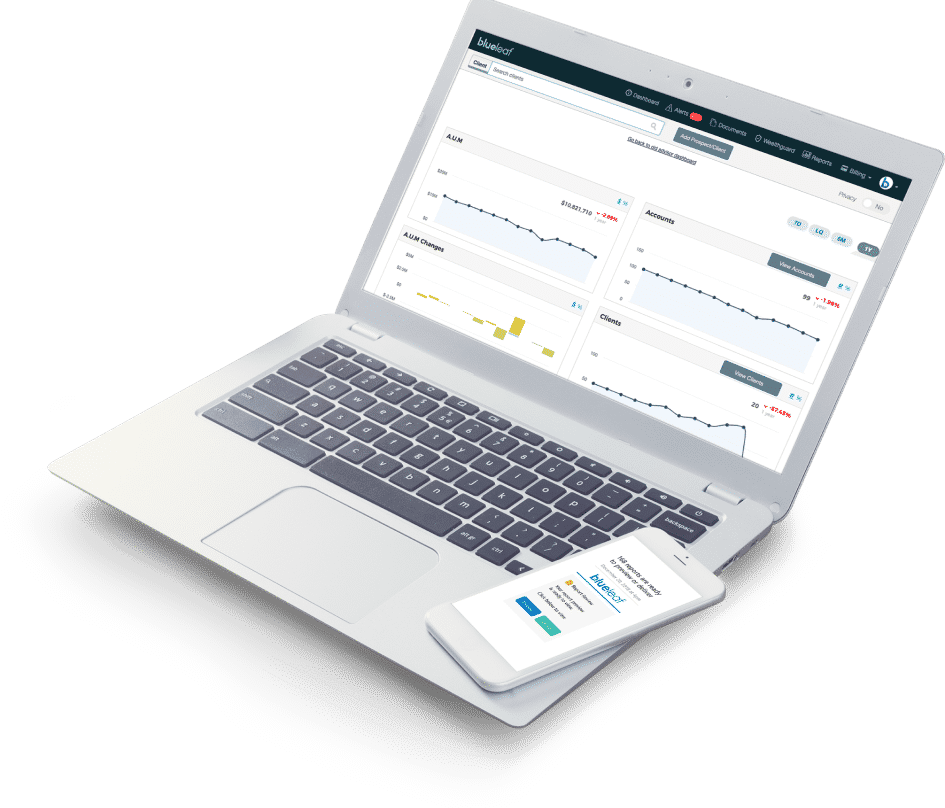
Think about doing a virtual meeting with clients where you walk them through their accounts, performance, and holdings in Blueleaf. With privacy mode, you don’t have to worry about exposing your entire Advisor Dashboard (see the image above) with the client. Instead, you simply toggle Privacy mode to “on”, which places your clients in a “waiting room” where they only see information you set while you pull you their account information in Blueleaf.

Place your clients in the waiting room, where you can choose and image and text that displays for your clients while you bring up their account information to present.
Blueleaf’s secure document vault enables secure document sharing with notifications. Clients can upload necessary tax documents and even allow other parties, like their CPA, to view their accounts. Anytime a client uploads a document, advisors receive an alert so they can verify they have all the information they need in real time. Advisors can also upload files, including meeting notes or investment policy statements. It’s seamless and secure, providing a cohesive experience for remote client service.
Check out a blog post we wrote:
Using Blueleaf’s Client Portal to Become Your Clients’ Favorite Video Conferencing Meeting
FAs on the Move are Looking for Digital Advisory Firms
Clients need digital engagement. Advisors on the move are looking for firms with the technology to provide that. We have a number of customers who have purchased Blueleaf solely to scale their advisor recruiting.
There’s more to it than just offering performance reporting and data aggregation through a client portal. Blueleaf has firm management tools that you can use to track individual advisor AUM and client activity, making practice management more seamless and efficient.
Most recruiting deals are structured with a client onboarding percentage and growth incentives. Blueleaf can show you when your advisors add clients and how much AUM they bring to the table.
Our dashboard enhances both monitoring and communication between firm management and FAs. It also makes it simpler to incorporate admins and assistants in your daily processes. Firms can add users without incurring additional costs from Blueleaf. We charge by the household, not the user.
The Allure of an Effective Prospecting Process
Let’s put this all together. Using Blueleaf fulfills the need that clients now have for virtual engagement. Our security and communications features help your firm overcome the digital disorientation of financial advisors. The Blueleaf advisor dashboard tracks FA activity.
The combination of all of these can be used to develop a prospecting process that will attract advisors who embrace the challenges of the digital age. That’s what you’re looking for. Virtual meetings and remote client service are the keys to scale in this new era.
Taking the Next Step with Remote-First Practice Management
With parts of the country reopening and a vaccine for Covid-19 coming soon, there is some hope that advisors will be able to do on-site meetings again in 2021. That’s good news for wealth management firms looking to get their office staff back to work. However, after experiencing the convenience of remote meetings many clients won’t want to leave their homes to visit a financial advisor.
All this means that your strategy will need to be a “both / and” approach. You’ll need to offer both in person and remote options for clients as well as your staff. We call that “Remote-First.” It’s the way Blueleaf has been operating for ten years.
Our team wrote a book on it. I consider it a collective effort because it took years of collaboration and problem solving to come up with an efficient remote-first business model. You can read the entire story and find a virtual blueprint for your practice here.
The post The Secret to Seamless Scalability in the New Digital World first appeared on Blueleaf.
]]>The post Blueleaf Tells All: Why Account Aggregation Isn’t Perfect & How We’re Fixing It first appeared on Blueleaf.
]]>When we first launched our platform, data aggregators were charging exorbitant fees and using complex customer interfaces that most advisors wanted no part of. It was clear that the technology was necessary, but not quite ready for mass consumption.
Since then, we’ve built a better data aggregation solution. In this article, we’ll review how we’ve addressed account aggregation problems and why Blueleaf is the best option if you’re looking for a holistic wealth management solution.
Connectivity and reliability has been challenging, it’s changing
It used to be that essentially all aggregation providers used the same unstable technology to connect to clients’ retail accounts – data scraping. Essentially the computer navigates a bank website like a human, using web pages, and “scrapes” the data from those pages.
The problem is that if anything on those web pages changes or if there is something new like an offer that the bank makes or terms and conditions that need to be accepted, the technology breaks. That means there is a lot of burden on the aggregators to constantly update their systems across thousands of institutions and a high burden on clients to “maintain” their connection by updating information at both their institution and the aggregator. Terrible.
The good news is that despite the fact that banks and other financial institutions have been reluctant to do more to facilitate a better way, things are changing. Consumers are beginning to vote with their feet and leave financial institutions that hold their data hostage. That combined with the fact that the largest aggregators have growing power and influence, the institutions are being forced to open up.
The largest of these institutions are now making available better options for connecting via more direct technologies. Our partner Plaid has been the most effective driver of these changes.
Blueleaf Improved Advisor and Client User Experience
The next account aggregation problem we identified was user experience. One competitor had software so complex that even our engineers had problems with it. How was a financial advisor going to embrace that? Wealth management needed something new.
Client portals were an emerging concept ten years ago. But they were often just repositories for static reports on managed assets stored in a shared files system. Our idea was to develop a portal that was interactive and displayed both managed and held-away accounts updated continuously. All your information was made available for both you and your clients to view on demand.
We knew from the beginning that improved data aggregation was meaningless without a great delivery system, so we built one. If you haven’t seen the Blueleaf advisor dashboard and client mobile app or portal recently, call or email our coaches to set up a demo.
Blueleaf Handles Client Service Issues so You Don’t Have To
If you’ve got a great user experience and a fair price, data aggregation should be perfect, right? Not quite. Technology is always evolving, so there’s always more to address. Unfortunately, without the right service approach, you can wind up with frustrated clients.
Blueleaf is solving that problem too. Our data connections rarely break and onboarding new accounts is typically a quick and painless experience, yet there are exceptions. When clients struggle with these issues, you don’t have to be on call as an unofficial member of the “geek squad.” They contact us directly.
This service model, coupled with new pricing and a better user interface, eliminates most of the headaches that advisors associate with data aggregation.
Blueleaf Doesn’t Hold Your Data Hostage
Aggregated data does not belong to the software provider. As head coach at Blueleaf, I have heard a lot of horror stories about advisors having problems trying to get historical data when they changed performance reporting systems. That doesn’t happen here.
We do not hold your data hostage. You can feed it via our API to another system, export it to a CSV file, or package it all up and take it with you if you leave us. Make sure you save the files if you do that, though. Of the few advisors who’ve left Blueleaf, many come back to us again.
An Experience Your Clients Will Love.
Clients will love the service you deliver with Blueleaf’s superior client experience.
The post Blueleaf Tells All: Why Account Aggregation Isn’t Perfect & How We’re Fixing It first appeared on Blueleaf.
]]>The post 14 Ways Blueleaf’s Account Aggregation Enables Proactive Insights and Helps You Add Differentiated Value first appeared on Blueleaf.
]]>In this article, we’ve compiled a list of uses for our account aggregation that can help you offer more proactive insights to clients and add differentiated value to your brand.
1. Holistic Wealth Management: Let’s begin here. Modern clients are looking for a one-stop shop where they can get advice on all of their accounts, not just the ones you manage for them. Blueleaf data aggregation gives you the ability to do that.
2. Influencing Client Growth: By seeing the entire financial picture, the advisor is able to make recommendations for new investments and influence clients who want to move money. That’s a differentiating service offering that can help you increase AUM.
3. Automated Onboarding: New clients don’t want to spend hours filling out forms and hunting down old financial statements. With Blueleaf data aggregation in our client portal, firms can offer automated onboarding that takes minutes, not hours.
4. Consolidated Reporting: No one wants to log in to multiple websites or get reams of paper reports in the mail every month. That’s not necessary when all client accounts are aggregated into Blueleaf. Consolidated reporting can be one of your core offerings.
5. Whole Client Allocation: Blueleaf allocates all holdings automatically using industry-standard categories or custom allocations that you can create in our settings menu. Advisors can use this information to structure managed portfolios to balance the allocation mix of held-away assets, such as a 401(k) or pension fund.
6. Aggregate Performance: We also track performance on held-away accounts, making it possible to view aggregate performance across all client assets. This can separate you from your competitors and alleviate client concerns during tumultuous market periods.
7. Seamless Integrations: Most account aggregation software doesn’t parse the data and deliver it by household. Balances, transactions, and holdings are fed via API to your planning and risk management tools, giving your clients a more seamless experience.
Check out a blog post we wrote:
Wealth Advisors Have a BlackBerry Problem…and Digital is Making it Worse
8. Data Portability: The number crunchers in your analytics department might prefer excel spreadsheets over fancy dashboards. No problem. Blueleaf data is exportable via CSV and can be adapted to any spreadsheet application.
9. Branded Viewing: Clients are logging into Blueleaf to see their aggregated accounts, but they are doing it through a log-in page branded with your name and logo on it. That page is fully customizable, so feel free to redesign it and make it your own.
10. Regular Updates: Blueleaf is the only advisor-level aggregation platform that will send your clients regular email updates on all of their account balances. We can also compile and automatically email weekly or monthly performance reports.
11. First Line of Defense: There are few things more satisfying than spotting a loss on an account someone else opened for your client. That insight is an opening for an advisor to build AUM. Clients should be open to suggestions when you alert them in this manner.
12. Fraud Detection: Clients often use multiple credit and debit cards for transactions, making them more likely victims for identity theft and fraud. The Blueleaf client portal displays all transactions in one place, making it easier to spot fraudulent charges.
13. Pro-active Recommendations: Viewing all assets and liabilities in one place gives the advisor the insights to make pro-active recommendations. Examples of this are advice to increase savings or pay off high-interest credit cards.
14. Center of Influence: This might be the most important item on this list. By positioning yourself as a holistic wealth manager, you become the sole center of influence for your clients. This will keep them away from competitors and digital financial apps.
Financial data aggregation is not a new concept, and it’s certainly not unique to Blueleaf. There are a number of applications that offer it, usually as an add-on or secondary feature. Our team doesn’t view it that way. Data aggregation is a core function for our platform.
Connecting to client accounts is pretty common, but the way in which we use that data is what sets us apart from other systems. The points laid out above provide insight into how our client portal and advisor dashboard can add value to your practice and differentiate you from your competitors. To learn more about that, contact a Blueleaf coach today.
Ready to learn more about Blueleaf?
The post 14 Ways Blueleaf’s Account Aggregation Enables Proactive Insights and Helps You Add Differentiated Value first appeared on Blueleaf.
]]>The post How a 360-Degree View Prevents Clients from Doing a 180 first appeared on Blueleaf.
]]>It’s easy for clients to become overwhelmed by the complexities of their finances, especially in a fast-changing market. Media distractions add to the overwhelm, getting noisier when clarity is needed most. Clients need more than advice on their managed investment portfolio.
Focusing only on the gains and losses of managed accounts leaves your clients without context. It narrows their perception about the work you do, leaving them little to focus on but raw performance. Without understanding their overall financial picture, they are prone to misunderstand the value you offer or undervalue your services. Of course, clients want advisors who address all of their needs, but it’s in your business interest, too.
Offering a 360-degree view of a client’s finances is the most effective deterrent to them doing a 180 and walking out your door.
Providing holistic advice and information isn’t an “optional” service any longer. In this article, we’ll show you how to use Blueleaf to provide it.
Accelerated Information Gathering Makes it Painless
Financial planners in particular are painfully familiar with the process of gathering account information. Prior to the development of data aggregation, this was a labor-intensive and time-consuming process that involved paper statements and hand entry into financial planning tools. That process made consolidated statements too expensive for all but the wealthiest clients.
But not all data aggregation is the same. Blueleaf directly supports clients using the system and automates ongoing messaging and management. Rather than asking for recent account statements, you can simply invite clients to use our client portal, which guides them through adding their accounts using our aggregation engine. It takes none of your time as an advisor and it updates all your connected systems.
This accelerated information gathering makes financial planning simpler for advisors and clients. It also gives wealth managers that 360-degree view we mentioned earlier. Because of that simplified experience, most advisors on our platform actually connect their prospects to the system creating a “try before you buy” experience and accelerating the onboarding of new clients using Blueleaf.
Consolidated Statements Deliver Critical Context
What else can you do with a 360-degree view? The average adult has to log in to a minimum of four websites to check balances on bank accounts, credit cards, retirement, and investments. Our platform eliminates the need for that. All accounts are consolidated into one statement.
Consolidated reporting adds context to the work you do for your clients. That context is critical to painting the “overall financial picture” clients need to understand how their wealth is being managed — and the value you deliver. Not providing the big picture can leave you fighting to hold onto clients…even when you’ve managed their money well.
Technology has changed the wealth management game and prospective clients assume all advisors can provide consolidation. After all, it’s the cornerstone to the holistic wealth management that clients demand. If you don’t have it, they’ll move on to one of your competitors.
An Experience Your Clients Will Love.
Clients will love the service you deliver with Blueleaf’s superior client experience.
Automated Communication Ensures Value is Delivered
Consolidated views aren’t valuable to your firm if clients never look at them. We didn’t build the Blueleaf client portal so advisors could hope their clients log in to it. Our platform is designed to proactively communicate with clients. We do that with automated communication.
Advisors can enhance the client experience and encourage them to engage online by scheduling regular emails with account balance summaries or performance data. This helps establish you as their main source of financial information and ensure your value is communicated.
And these branded communications help drive growth via your most important channel: referrals. Referrals come when your company brand is synonymous with good service. Automated reminders that you’re providing a positive, seamless user experience makes it a no-brainer for current clients to send friends and family members your way.
Increased Efficiency Makes Growth Possible
Data aggregation makes consolidated statements possible. Automation delivers those statements, increasing client engagement online. All with virtually no staff involvement. That is how you increase efficiency.
We recently asked advisors on our platform what their biggest concern was for 2021. The answer was the same one we’ve gotten every time we’ve made this inquiry. “Growth” is what many wealth management firms consider their top priority. We can help.
Increased efficiency makes growth possible. Using Blueleaf data aggregation and delivering consolidated statements with our automation engine will make you more efficient. You’ll still need to engage clients personally, but the maximum number of clients you can support will be much greater.
Look for more on this topic in the upcoming weeks, including the release of our next eBook, titled “Remote First,” which will show you how to grow and manage a virtual advisory practice. Subscribe to our blog so you don’t miss any updates.
The post How a 360-Degree View Prevents Clients from Doing a 180 first appeared on Blueleaf.
]]>