The post Designing Great Wealth Management Experiences Leveraging Mobile first appeared on Blueleaf.
]]>In the last few articles, we’ve outlined what a big challenge mobile apps can be for advisors and firms, the key elements to designing a great app, and information about the new Blueleaf mobile app. In this piece, Blueleaf CEO John Prendergast and Alloy Labs Alliance CEO Jason Henrichs discuss the impact of mobile on the wealth management industry and what advisors and firms need to consider as they embark on building their own mobile offerings.
Listen to the interview below or Read the interview transcript to hear Prendergast talk more about the challenges and benefits of designing a mobile app — and why simplicity is key.
Jason [00:00:05] Why is design so important? A lot of industries have figured out design is very important, but why? When we look at digital technology and financial services, why is it so lagging?
Blueleaf is running counter to that trend and putting a big focus on design. Why is the industry so backward, and why is Blueleaf willing to swim upstream there?
John [00:00:38] I’ll start with the first part of that question, why is design important at all? I think the first thing you get to recognize is design isn’t just how something looks, it’s how something works. It determines how you experience that thing. Because of that, it creates pain or happiness in what you’re doing.
When we’re talking about software at work, it means pain or happiness at work all day long. That drives cost. It drives the amount of time things take, it drives training, and it drives errors. Errors and omissions or extra time and the related extra cost are tough in an industry like wealth management that has shrinking margins and some real challenges.
One of the reasons it’s a focus for Blueleaf is because wealth management software has been in really bad shape design-wise, even way back when we got started about 10 years ago.
And unfortunately, for the most part, it still is.
Jason [00:01:50] What makes it uniquely hard to do really good design within wealth management?
John [00:01:56] I think that’s a great question. Wealth management stakes are really high for both the advisor and the client. It’s almost like medical services in that respect. The information is complex and it can be abstract, which makes it difficult to make it simple and understandable. The other part is that wealth management is a collaborative place. It is a collaboration between advisor and client that creates wealth management interaction. Advisors and clients have different needs and different levels of comfort with the information that’s being presented. They also have different levels of comfort with technology, generally. It’s a really challenging context to create great design solutions that deliver for all the stakeholders.
Jason [00:02:58] So isn’t it easy to go copy that, though? Someone else can figure it out and build a great design, so why don’t others just look at that example and do the proverbial fast follower?
John [00:03:13] You’d think that was the case, right? It sounds so obvious. “Hey, it’s a design…I’ll just copy it.” But we actually think design is a completely enduring competitive advantage.
Think about the iPhone. It took years for Android to get anywhere near the simplicity that iOS delivers. Why? I think it’s because it goes deeper than just copying how something looks…it’s also copying how it works. That’s a much more massive task than you might imagine. There’s a lot under the surface about how something works. The reason that so few try, is that that’s only a snapshot in time — how this thing works today.
To truly replicate innovative software design and allow it to evolve as the market evolves as customers evolve, you have to understand why things work the way they do. In trying to copy the design and get it to behave in the right way, you need to understand the guiding principles that govern that behavior, which is a monumental task. If you’re not an insider, it can’t realistically happen.
Jason [00:04:24] It sounds like one of the most important points around this is context. Even if you do try to copy an application, unless you’re perfectly re-creating that context, the design is going to be a fish out of water.
John [00:04:49] That’s exactly right. It’s that context that gives all the information meaning. Without that context, without understanding the why and then being able to deliver that to the end-user, you create a confusing experience.
Jason [00:05:05] Why mobile? Why mobile now? There are many things — like paying bills or transferring money — that naturally lend themselves to mobile. The business case for a wealth management mobile app isn’t as obvious. What is the new context that makes mobile so important right now?
John [00:05:28] Most markets have been mobile for a while, and that’s followed demand in those markets. Wealth management demand and interest in mobile have been slower to develop. It just has. But we’ve seen a pretty distinct shift in the past 18 months and pretty clear usage trends toward mobile now.
That probably reflects the journey of both advisors and clients to embrace mobile, especially for more critical or complex tasks. Both advisors and grandma have been using Facebook for a really long time, but wealth management is a more critical task. For that reason, it just takes longer for people to embrace. However, it’s really, really clear to us that now is the time to deliver something exceptional in mobile wealth management.
Jason [00:06:19] What is the biggest frustration that you’ve seen between advisors and clients when it comes to mobile? Now that we’re seeing mobile enter into the wealth management space, what’s still broken?
John [00:06:36] What we’ve observed is that mobile tends to simplify things in other markets and contexts, but in wealth management, it appears to be more of the same thing. Mobile in wealth management has been more of the same complexity and more of the same designs just pushed into a smaller box. I think that’s because software developers simply avoid making the necessary choices that mobile requires.
What we did differently and what we do differently is we start from scratch. We started from scratch in our thinking and we made design choices that forced us to simplify. That’s obviously led to a simpler experience, which we’ve been told is quite beautiful. There’s something beautiful in simplicity, and it feels good to use.
Jason [00:07:37] There was a recent J.D. Power study around mobile apps and their importance in wealth management. It said three very important characteristics mattered to the client: simplicity, security, and personalization. Why was simplicity so hard to get at in terms of the choices that Blueleaf was making?
John [00:07:59] Obviously, security is your starting point in wealth management. If you’re not secure, you don’t have anything. That’s your foundation rather than a focus. It’s something you live and breathe. Personalization comes from the data, so it’s inherent in the application. The data is all personalized to each person.
Simplicity is the thing that you need to focus on because it takes effort to achieve.
And simplicity requires very clear thinking and making very challenging choices about what to include and, more importantly, what to leave out. That takes a great deal of time. Most application developers don’t spend the time or aren’t willing to make those challenging choices. That’s why we felt it was so important to focus on the simplicity element.
Jason [00:08:57] It seems the fear of leaving something out that the client or the advisor might want leads to that “more is better,” which actually can be overwhelming. What advice would you give to developers or advisors who are trying to build this out in terms of understanding what features and functionality are important to clients and in which context?
John [00:09:22] If you’re trying to create a simple experience, then first and foremost, you’ve got to focus. So each application has to have a main focus — a single focus — so it’s not trying to do everything for everyone. Within that application, any view or any interaction has one purpose. What you see in many other applications is people build “shoulds” or “musts”.They throw everything in, making it complex, difficult to use, and difficult to understand.
Another important concept that we use is something called progressive disclosure. Sometimes you need to make available a lot of information, but you don’t want to just throw it up on the screen. What you do is you allow folks to ask for that information as they need it. Highlight what’s necessary, show what’s necessary, and then allow people to ask for more information on that. That’s counter to the way that a lot of web applications have traditionally been developed to reduce the number of clicks. But it turns out simplicity requires almost the opposite decision.
In terms of understanding your users, it’s really critical to use actual behavior — not their words — as a guide. So we interview users and talk to folks, but we don’t listen to what they want as much as why they want it. Then, we pair why they want what they want with their actual behavior. That is how you illuminate what’s really going on in an application. That’s been our approach. I think you have to have a point of view on what the application needs to do, and you need to follow that. That’s how you maintain all that focus.
Jason [00:11:23] It’s not often you hear “you need a point of view”. I think that’s a very important piece of advice for advisors and developers figuring out what they trying to accomplish. It’s important to really nail that point of view to be differentiated. What would your biggest word of caution be to an advisor that’s going to get started providing a mobile app or mobile experience to their clients?
John [00:11:49] The first caution I’d say is: don’t depend on your clients asking for this. Only the noisiest will ask, and by that time, will be too late. We just did a case study on BlackBerry. BlackBerry had very high customer satisfaction scores right up until the end. This is because clients don’t necessarily ask for what they want. They just go where it’s available. I think you have to take a look at the context and see the evidence out in the world, not necessarily within your own client base. That would be the biggest caution because that will lead you to wait. Waiting creates opportunities for competitors who are better equipped to deliver a digital experience that clients clearly want.
When you do decide to go mobile, you want to focus on simplicity. Clearly, we believe that that’s a critical component. That is the driving force behind our design to make sure that it’s something that clients will use. You find something that looks beautiful and reflects well on you, your brand. Also, start slow. You do this with a handful of clients and roll out slowly. Even better still, find a vendor that will help you with that rollout and that directly support your clients with their tech needs as that rollout happens.
Jason [00:13:16] One of the really important points you just made is that this is not a “set it and forget it” sort of thing — that you develop a mobile app and it’s done and we’re off to the races. I like the idea that you just need to start and start somewhere. So, where would you suggest an advisor get started to really just start the journey?
John [00:13:41] I think you’ve got to pick a mobile app that you’d like to roll out and share with clients. I think that’s the beginning. You have to make the decision to go ahead and do that. That’s first and foremost. In some ways, that’s the hardest thing, right? Inaction is the greatest enemy. So you need to get going. Once you get this in the hands of a handful of your clients, the rest starts to take care of itself. You’re going to see higher levels of satisfaction and engagement from those clients. You’re going to want to get this to other clients, and the snowball rolls downhill.
Jason[00:14:25] In getting this snowball rolling downhill, are there any pitfalls related to rolling out a mobile application to your clients? What should an advisor prepare for?
John [00:14:38] Absolutely. It’s a new device, and it has different support requirements, so I would make sure that I partnered with a vendor that could directly support clients with those needs. The last thing an advisor wants to do is become the geek squad, the team from Best Buy. You want to let tech experts do that support so that you can do what you’re hired and paid to do, which is manage money and help people grow wealth.
Jason [00:15:17] Fantastic. John, one of the things that became very obvious in the course of the interview is that, when advisors are looking to roll out a mobile platform, it is absolutely critical to find a partner that understands their space. It’s important to find a partner that understands their business on the client-side as well as the technology. I think the technology may be the least important. It’s about tying the design together to meet at the intersection of what the advisor needs and believes and what the client needs and believes. That is not insurmountable. As advisors are looking to become more mobile and more tech-savvy, finding that balance is absolutely critical.
Based on the discussion between Prendergast and Henrichs, it is clear that simplicity is a key component of a successful mobile app in wealth management. Advisors and firms looking to launch a new mobile app are well-advised to find a partner that understands the wealth management space just as well as they understand mobile technology. This is the best way to ensure that any mobile app offering is able to meet the needs of all stakeholders in a balanced, simple way.
Another key theme is the importance of focusing on mobile now. While wealth management has historically lagged behind on the technology front, advisors that embrace the trend toward mobile will gain a critical competitive advantage over those who remain stagnant in the status quo. Identifying the purpose and focus for a wealth management app — followed by action — will be paramount to staying ahead of the digital curve.
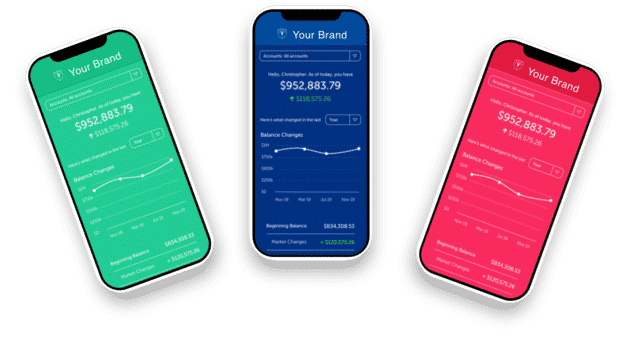
Check out MyAdvisor by Blueleaf
A powerful client mobile app with a personal touch.
The post Designing Great Wealth Management Experiences Leveraging Mobile first appeared on Blueleaf.
]]>The post Blueleaf Has Launched Its Mobile App…Upgrade to Beautiful first appeared on Blueleaf.
]]>Mobile is tricky and most advisors are hesitant to get an app due to the lackluster options available in the market. Some end up yielding to their vendor’s mobile app, which typically offers a sub-optimal experience.
We’re here to tell you there is another way.
There is a way to make your clients say “wow” and impress your clients and prospects alike with a beautifully-designed app that’s powerfully simple — and that attracts and retains clients.
Beautiful, Functional Design that Travels Well
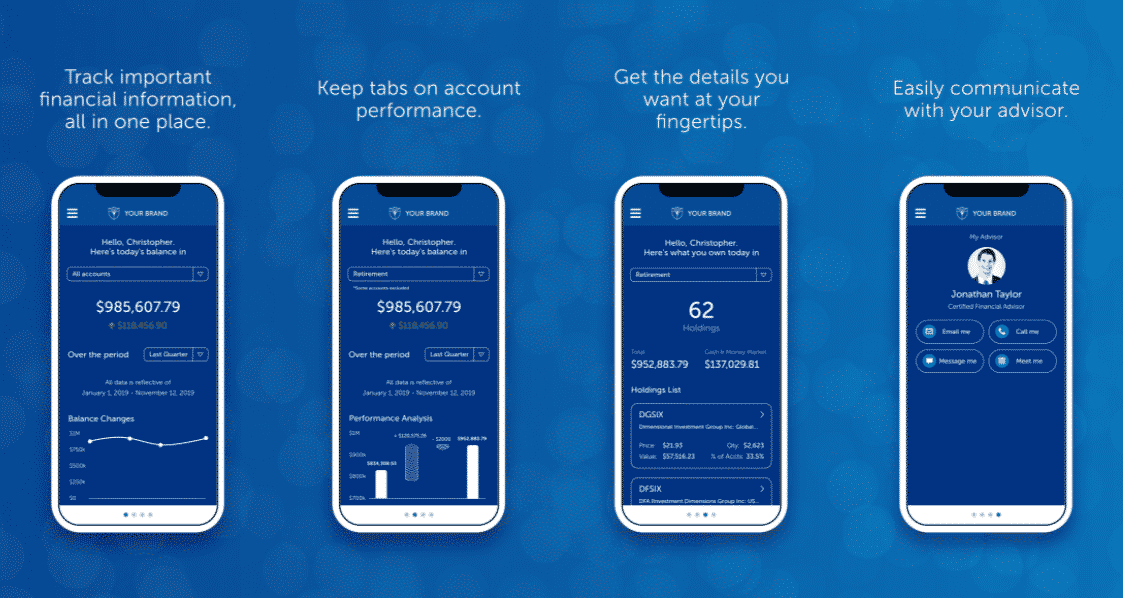
MyAdvisor by Blueleaf — our new mobile app offering — enables you to provide your clients with an elegant experience no matter where they go. Though it will feel familiar to current Blueleaf users, the new mobile app significantly extends our leading client portal user experience to create an experience that is uniquely elegant in wealth management. Not only does it allow your clients to stay connected to their money (and you), it provides answers to their most pressing questions in an easy-to-understand way via simple-to-navigate design. The app caters to users, regardless of age, and embraces a simple, elegant design. From the clear graphics to rich colors and clear text (with good contrast), the app is incredibly easy to use.
Connected Communication and 24/7 Self-Service
The mobile app streamlines communications with clients and offers a self-service option that doesn’t require clients to be near their computers, allowing your clients to keep a finger on the pulse of their money remotely. While advisors remain in control of communication channels and can set available “meeting hours”, clients can use the app’s calendar feature to book time on their own, avoiding the inefficient back-and-forth that would happen otherwise. Clients also have the option to text or email if that is their preference, removing the burden to adhere to a communication style that they may not favor.
The self-service features allow clients to get answers from anywhere that is convenient for them, extending the portal service to mobile devices. Clients can quickly and easily find all of the information they need, all from the convenience of their smartphone:
- Balance Overview—Clients can quickly view their portfolio balance to understand what’s changed and why.
- Performance Details—Give clients insight into the performance of their portfolio and individual accounts over various time-periods.
- View Holdings—Show clients a breakdown of their individual investments, including held-away accounts.
Intentional Design, Features That Keep the User In Mind
The app design employs a logical flow that progressively discloses information, only revealing information as needed, in context and at the users option. We also took special care to craft information around clients’ top questions, making it easy to get straightforward, focused answers:
- How much money do I have?
- Is it more or less than last time?
- How much/how is it doing?
- What do I own?
- Where/how do I get more help?
Advisors and firms can personalize the app with their own settings for contact methods, color, and branding. Even if an advisor chooses not to customize the experience, the app includes thoughtful defaults that preserve the professional appeal of the mobile experience.
Visually, the app stands out in a sea of black and white apps. Your clients will love how easy, simple, and clear it is to view balances, performance, and holdings. Large fonts, bold colors, and clear, simple graphs make it seamless for the user to quickly digest the key takeaway of the screen. This helps you to answer your clients’ most pressing questions without creating new ones.
Digestible Data and an Experience that Fosters Connection
The reigning trend in financial services software design is to offer an overwhelming array of functions. We think this is a mistake. It is just not a good experience for most users. We opted instead to reduce complexity and complications while helping your clients simplify their financial lives.
Clients can also drill down and navigate through data smoothly, viewing data for one, some, or all of their accounts quickly. Swiping and navigating through the app is a breeze as account and time period selections are set and saved for each time a user returns. Multiple, repeatable navigation options allow clients to view the data that matters most to them and return to the same screen where they left off when they close and reopen the app.
The entire experience makes advisor engagement easy and fosters a more convenient connection between you and your clients. You don’t have to be a technical wizard to make the app play nice, either. The advisor settings are simple and smart (with impressive defaults) while still keeping you in the driver’s seat. Clients can easily reach out to you in a variety of ways, both directly from the app and from their mobile devices.
We believe the ability to remotely manage client service will help pull you and your clients closer together and deepen your most important relationships. How? Through the MyAdvisor app, you now have a presence in your clients’ mobile devices and they now have access to their data whenever and wherever they may need it — along with a fast line of communication to you. This app is designed to increase regular engagement with Blueleaf and facilitate a more favorable experience for both you and your clients.
ROI-Driven Design That Makes You Look Awesome — And Different
When it comes to mobile app development, beauty is just one tenet of a great experience. A sophisticated, elegantly functional app moves the needle in the right direction in terms of ROI. MyAdvisors by Blueleaf allows advisors to turn their firm mobile, providing clients with a convenient way to get the answers they need instantly and easily, wherever they are. What’s more, it offers a branded and enjoyable mobile experience that sets you apart.
This was the impetus behind our thoughtfully-designed app that includes visually-appealing graphs and ledger formatting to help clients access a holistic view of their finances and answer their top questions. That includes meaningful insights around balances, performance, and communication options as well as any other information they may be looking for. On the communication front, we make it easy for you and your clients to talk in a way that suits you both, with easy, in-app scheduling and direct messaging. The best part? MyAdvisor is a cost-effective way to increase service and save money.
Improved Reputation & Client Loyalty
We believe a wealth management mobile app is only as good as it makes you look. We designed MyAdvisor to help you show your clients the full scale of your value, including your ability to be responsive to their needs. With information available at their fingertips and a variety of convenient communication options, it’s a no-brainer for clients to continue doing business with you — and for your prospects to choose you over competitors.
Retention extends beyond clients, so our mobile app also allows you to modernize your firm and stay competitive in recruiting advisors. It’s a win-win: you attract and retain top talent and your advisors get the technology and quality experience they expect. Our communications options also extend to your team of advisors, helping you build and nurture those relationships seamlessly.
Support That’s a Cinch — and Saves Time
My Advisor was designed to mirror what clients already see in the Blueleaf client portal, so clients can navigate the app more intuitively and without an unnecessary time-intensive commitment from the advisor for onboarding. Other mobile apps cannot say the same and often require extensive time to onboard a client to another confusing application. MyAdvisor by Blueleaf eliminates time spent answering questions like “what affected balance,” as that information is clearly outlined within the app. That means you have more time to address more substantial questions from clients, or just check in to nurture and grow the relationship.
At Blueleaf, we know that supporting a mobile app has unique considerations, so our experts are here to make things as easy as possible for you and your clients. From branding and setup to onboarding and ongoing technical support, we’re here to help.
We’ll help you choose and define your logo and color choices as well as client communication options. Our special onboarding team will help you and your clients navigate the app stores and set up your mobile account via unique email templates and client materials to get your clients using your app in no time. Nothing stays the same forever, so we also offer ongoing technical support to assist when your client needs to change devices — and as the mobile landscape evolves. When you and your clients have questions, we’re just a phone call away.
The post Blueleaf Has Launched Its Mobile App…Upgrade to Beautiful first appeared on Blueleaf.
]]>The post How a Beautifully-Designed Mobile App Attracts and Retains Clients first appeared on Blueleaf.
]]>Technology-enabled remote and digital advice is on the rise as clients get more comfortable checking in on their finances from the comfort of their own home or on the go. This has led to fast-rising expectations around mobile, even as many advisors and firms lag behind when it comes to digital and mobile options. Clients are taking note, making it imperative that the wealth management industry as a whole begin to acknowledge the importance of mobile.
Just having a mobile app is not enough. We need Great mobile apps — apps that attract and retain clients — require beautiful and functional design that caters to the unique needs of everyone from Gen Z to grandma. The key is to find a balance between functionality and simplicity, which can be a tall order in an industry that often embraces the complex. Here are a few ways to ensure that a mobile app is above par and a reason for clients to celebrate.
Check out MyAdvisor by Blueleaf
A powerful client mobile app with a personal touch.
Design That Works: Visually Appealing — And Functional
When asked why design is an important consideration for wealth management firms and advisors, Blueleaf CEO John Prendergast said, “I think the first thing you have got to recognize is design isn’t just how something looks, it’s how something works. It determines how you experience that thing. And because of that, it creates pain or happiness in what you’re doing.”
In other words, a beautifully-designed mobile app is functional, simple, and easy to use. This underscores the importance of finding an app with creators that have done their due diligence prior to the design stage. An app designed with a data-driven approach will be sure to look at users’ actual behavior rather than their words as a guide. Interviewing users to see what they value is a good first step, but running that against the data from actual behavior when they use the app is critical.
Another driving factor behind an app’s success with clients is whether or not the app’s creators have a point of view on what the mobile app needs to do — and whether those creators maintained focus on that purpose throughout the design process while tempering with a bias toward simplicity. A wealth management mobile app should not try to do everything for everyone. Apps that build around “shoulds” and “musts” add unnecessary complexity and become difficult and frustrating for the end user.
When evaluating apps for your firm, remember that visuals and function are tightly coupled when it comes to app design. In both cases, less is more. For example, progressive disclosure (displaying only necessary information and enabling people to ask for more information if they want) can keep the design clean and simple without overwhelming the user while still giving them everything they need.
Color
When it comes to color, there is an entire psychology behind choices and how those choices impact users. Warm colors like red and yellow can spur feelings of comfort and warmth while cooler colors like blue and green are calming. Of course, perceptions of color are subjective, but it’s good to be aware of some of the universal psychological impacts, too. For example, strict testing environments have illustrated that bright primary colors are the highest-converting colors.
Some suggest minimal color usage is ideal to preserve a positive user experience. Even with limited color usage, implementing high contrast colors in the interface can be beneficial for calls to action (CTAs) to help shift users’ attention toward the action they should take.
Type
Another point of evaluation for choosing an app is how type is used. If there’s one hard and fast rule, it’s that fonts should be larger than the average desktop email. Mobile UI should implement at least 16px paragraph font size and at least 22px font line-height. Apps with text-heavy pages should consider bumping up the size even higher.
On the other hand, interaction-heavy pages benefit from small text sizes of between 14px and 16px. In all likelihood, larger text sizes will be used for titles and other important text and smaller sizes for less important items. Forms should leverage a text input font size of at least 16px. Testing on an actual mobile device is a great way to make sure text size is not too hard on users’ eyes. The bottom line is that text needs to feel big to be comfortable on mobile devices.
Touch Targets
Touch targets, the on-screen elements that a user is meant to touch, click, or otherwise interact with, should be large enough for the user’s finger. Touch targets that are difficult to tap accurately (read: too small) can leave users feeling frustrated, leading to a negative experience. Controls should measure at least 44 points x 44 points (on iOS) so users can accurately tap them with a finger.
White Space
White space — the area between design elements — is your friend. White space includes space between characters on the screen. There are two kinds of white space: micro white space and macro white space. The former includes white space between lines and paragraphs. The latter is the larger white space between major layout elements (to the right and left of content and in between content blocks). While how you use white space will depend on your content, design, user demographics, and branding, the general rule of thumb is: more is better.
Design Impacts the Bottom Line
Choosing a well-designed mobile app can impact the bottom line — significantly. The best practices above are tried and true techniques of mobile app developers and designers that have been doing this for a while and who have collected user feedback and data. The benefits of well-designed software run the gamut, but the biggest perks for advisors are increased loyalty, reduced costs, efficiency, scalability, and enhanced competitive advantage.
Just as a poorly-designed app can ruin reputation, credibility, and loyalty, a well-designed app can have the opposite effect. A satisfying user experience reflects positively on the firm that it belongs to. When clients know they can turn to their advisor’s app to get instant and easy-to-understand information about their money, they’ll be more inclined to stick with what works. In the best cases, they may even tell their friends and family about how easy it is to keep tabs on their money, all from the convenience of their advisor’s mobile app.
A great mobile app also means that it’s easier for advisors to help clients make good decisions with their money. It reduces the costs associated with having to walk clients through a bad mobile app experience. Depending on what a mobile app does, it could also help automate some processes that normally steal time away from helping clients directly. Apps that automate reporting or communication can increase efficiency and even improve the scalability of a wealth management business.
One of the most impactful ways mobile apps aid advisors is by enhancing competitive advantage. A well-designed app that is innovative, simple, and easy to use can help an advisor or firm stand out to prospective clients while keeping current clients delighted.
If all this seems overwhelming, that’s ok. We know that most advisors are not mobile UI designers. The important thing is to understand the importance of mobile for your firm, or rather, the importance of a great mobile experience. From there, you can partner with a developer to create your own app or find a partner within the wealth management space that has already done the heavy lifting. You’ll want to stick around because we’ll be talking about a potential partner in the coming days (hint: it’s us. We just created a killer mobile app you won’t want to miss).
Suggested Articles:
The post How a Beautifully-Designed Mobile App Attracts and Retains Clients first appeared on Blueleaf.
]]>The post Your Customers Hate Your Wealth Management Software — And We Don’t Blame Them first appeared on Blueleaf.
]]>What’s more, digital platform wealth management companies and robo-advisors are flooding the market, driving up consumer expectations around technology-enabled remote and digital advice more drastically. McKinsey points out that the digital advice segment grew by more than 90 percent in 2017. Mobile is a key part of that.
Yet many advisors and wealth management firms have been dragging their feet when it comes to offering mobile apps. In many ways, advisors are stuck between a rock and a hard place: they know mobile is important but their vendor doesn’t offer mobile, or — more common — the mobile experience is awful.
We know clients aren’t impressed. The J.D. Power 2019 U.S. Wealth Management Mobile App Satisfaction Study℠ reported that customer satisfaction around wealth mobile apps falls far behind those of other consumer financial companies. Advisors and firms know that happy clients are more likely to stay with their advisor and even expand the business they do with those advisors. So what gives?
Mobile Apps: Damned if You Do, Damned if You Don’t
When it comes to mobile apps, there are two things to understand: 1) not having a mobile app is not OK in 2021, and 2) having a bad mobile app is not OK in 2021. We live in a mobile world and consumer expectations are high. Even grandma likes to be able to see how her money is doing from the convenience of her smartphone in-between “liking” photos of her grandkids on Facebook.
If you’re tempted to think that it’s just Gen Z’ers that are having a field day with mobile, think again: Four out of five (81%) of Americans now own smartphones, and 95% of U.S. adults that earn over $75,000 annually own smartphones. Those smartphone owners, on average, use 30 apps each month.
The success of your mobile app depends on simplicity and personalization.
Unfortunately, most wealth mobile apps are inconsistent on both fronts. In fact, the J.D. Power study noted that one-third of customers said their firm misses the mark when it comes to security. Just half of customers reported that their app provided personalized advice and insights.
Firms get caught up in front-loading features and functionality without considering whether or not their clients actually want those features and functionality. Without a data-driven approach, the mobile experience falls flat on clients who feel slighted that their individual needs weren’t considered.
Simplicity and ease-of-use are also key. Unfortunately, there is a stark disconnect between how firms design mobile features and how their clients experience them. The J.D. Power study showed that just over one-third (36%) of users said that features they considered the most important were not easy to use. Big misses in your mobile app can lead to big misses in the bottom line.
Bad Design, Bad ROI
Features and functions are clearly important but there’s one more critical ingredient that can make or break client experience: design. Mobile app design has consequences. Mobile apps that don’t appeal to their users can actually incentivize those users to take undesirable actions.
Snafus like ambiguous notifications or visual clutter are not just messy, but they can compel them to abandon the app (and your advice) altogether. Confusing your clients and making them jump through hoops that don’t matter to them is frustrating and saps their enthusiasm for your app. In other words, bad mobile app design has an emotional impact on your clients. Clients log in expecting your app to help make their lives easier. If it ends up making things more difficult, they will bail and possibly seek out a competitor that provides a better experience.
The business impacts of bad mobile design are not insignificant. Aside from losing loyal customers to a bad experience, bad mobile design can lead to:
Reputation Damage and Decreased Loyalty
Wealth management firms know better than most the importance of reputation, credibility, and client loyalty. So take heed when we highlight just how much damage a poorly-designed app can do to those things. A dissatisfying user experience isn’t just frustrating to the user but it calls into question the reputation of the entity that created the app — your firm. In the era of social proof, this damage can spread like wildfire with bad app reviews and word of mouth, having devastating effects on your client base and revenue.
Increased Support Costs
Advisors love helping clients make good decisions with their money, but acting as technical support to help those clients figure out how to use a mobile app falls much lower on the totem pole. A poorly designed app doesn’t just lead to frustrating experiences for advisors and clients, it can increase costs, too. This bears out several different ways. Time spent helping a client navigate a confusing or clunky mobile app takes time away that could be spent helping that client (or other clients) manage their money. Considering that Baby Boomers control more than 53% of the wealth in the U.S., advisors must be cognizant of how these users engage with mobile technology. Yes, they use it. But they are less adept at troubleshooting problems than their digitally-native counterparts in Gen Z (and millennials). Time spent walking each and every client through a bad mobile app experience can drain time and resources from a firm fairly quickly.
We get it: you’re a wealth management advisor, not just a digital platform or robo-advisor. That doesn’t make offering a (well-designed) mobile app any less important. Mobile is here to stay, and your clients now expect the best experience possible. The question is, is your mobile app here at all? If you do offer a mobile app, does it have what it takes to keep your clients happy and engaged?
Stay tuned as we walk you through how a well-designed app can help you attract and retain clients.
Suggested Articles:
The post Your Customers Hate Your Wealth Management Software — And We Don’t Blame Them first appeared on Blueleaf.
]]>