The post 3 Steps to Turn Your Advisor Website into a Prospect Magnet first appeared on Blueleaf.
]]>The challenge that remains is how to attract the right prospects and get them to make the initial contact.

After referrals, the most cost-effective way to attract new clients today is digital marketing. To be successful with digital, you need to grow relevant traffic to your website and get these visitors to opt-in to an offer. The best way to do this is to develop a coherent marketing campaign. You can do it relatively quickly using free or low-cost tools.
Here are the 3 steps that you need to take.
Step 1: Create a persona for your ideal client and identify your target keyword
Start by interviewing some of your best clients and ask them what they value most about your service. Capture the language that they use. Their words are very important. You can use this language in your copy.
Use the Persona App tool to sketch out at least one profile or persona. The app includes some suggested questions.
Your persona work should also help you identify the words that your ideal client may use to search for your service. Google offers their free keyword planner to help you evaluate these search terms. You have to sign up for a free Adwords account to access it. Here’s a video to show you how to use the Keyword Planner tool.
The focus keyword should be a top search term that your ideal customer would use. The keyword should have high search volume and low competition. We are going to use “financial planner” even though it is very competitive because of the potential to rank in local search.
Step 2: Create a landing page
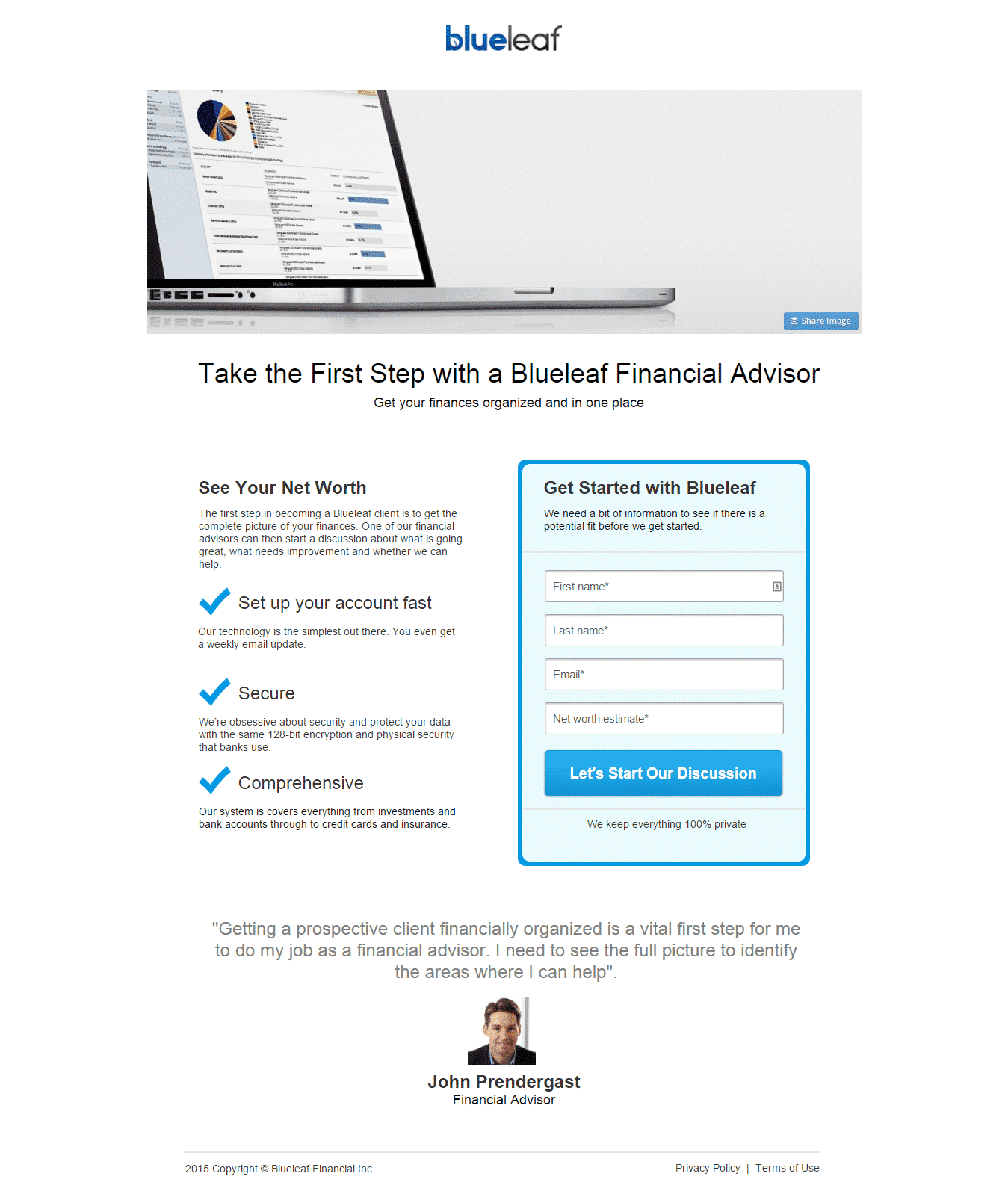
A landing page is a webpage with a single objective. It does not have the normal navigation since you want the visitor to complete a form, and submit their information. There are a number of landing page builders. We used Unbounce. We created this page with their simple drag and drop tool for the fictitious “Blueleaf Advisors”.
You can use the copy for inspiration and right click to get the image. This offer assumes that you are using some kind of account aggregation software. This is a “bottom of the funnel” offer because it targets people that are ready to seriously consider either changing their advisor or getting started with one. Refer back to your persona model to help adjust the language to best fit your ideal client.
You can set up a simple notification in Unbounce to let you know when you get form submissions.
Step 3: Promote the offer
You have your core asset for the campaign in place. Now you need to promote it. Your strategy depends on the strengths of your promotional channels.
Here are some options.
a. Homepage
The home page of your site will get the most traffic. Most home pages have a lot of distractions and many do not have a clear objective. Simplify your homepage and focus on your “lead magnet” offer only.
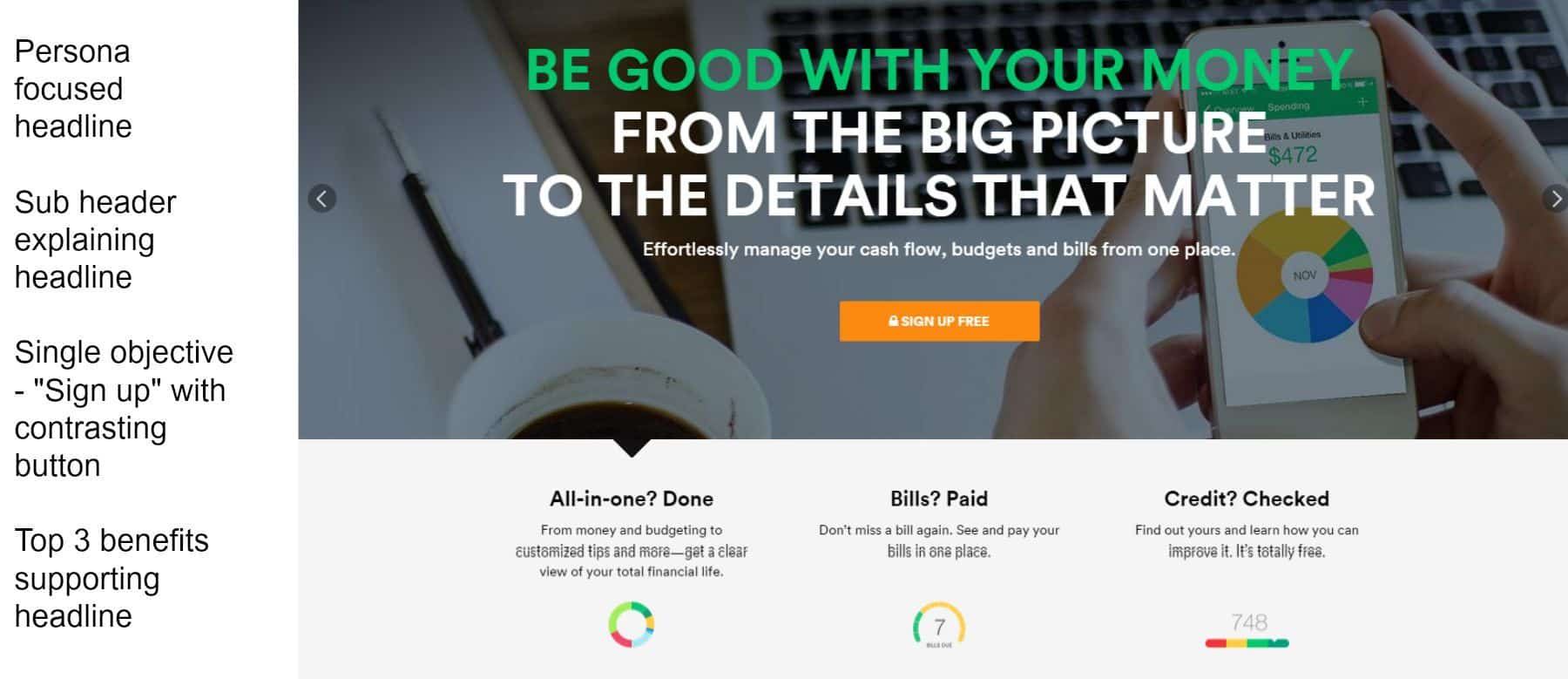
The home page should be optimized around your target keyword. Here’s a guide on how to optimize a web page. How you do it depends on your website software.
b. Web page
A dedicated web page on your process will help define your onboarding process and also provide another opportunity to rank on a different but related target keyword. Financial planning or retirement planning might be good targets.
c. Blog post
A blog going into more detail on initial steps and your approach. It provides another opportunity to rank for another related keyword. Remember to include a call to action (CTA) at the bottom of your blog post. A call to action is a link or button stating your offer (“Let’s Start Our Discussion”) that links to the landing page. Check out the bottom of this post for a CTA example.
d. Email
Email continues to be the most cost effective digital marketing channel. If you have built a list of potentials with a newsletter, promote the offer directly to help move the potentials to prospects.
e. Social
Social media can be a promotional channel if you have built a following. Consider creating visual posts to get more engagement. Think about creating a Slideshare to provide a short visual overview of your process. You can add a lead generation form to Slideshare (currently $4 per lead) and include clickable links to your landing page.
f. Paid advertising
A good place to start is LinkedIn advertising. You can either promote your blog post linking to your offer page or advertise the offer directly. LinkedIn allows you to target by title and industry. It has a relatively high price per click, but the traffic will be very targeted. Here’s how to get started with LinkedIn advertising. LinkedIn only gives you a couple of days to achieve their required click through rate. They stop the ad being seen after that. You will most likely need to create a few different ads campaigns until you come up with an ad that performs well.
Adwords is another option. Here’s a guide to help with setting and running your Adwords campaign.
g. Center of Influence (COI) marketing
Remember to work with your COIs to get increased exposure to the offer. Access to their audience might double or triple the number of people that you can reach.
Next Steps
You can now use the steps outlined in high growth financial advisor secrets post once you get some sign ups.
Bonus tip: Testing the effectiveness of your digital assets is vital to increase your conversion rates. A conversion rate is simply the number of sign ups divided by the number of visitors to a page. Increasing your conversion rate from 2% to 4% will double the number of prospective clients for you. Optimizely is a free tool that allows you to send up tests without any coding. Check out Optimizely’s overview of AB testing or split testing and their tool.
The post 3 Steps to Turn Your Advisor Website into a Prospect Magnet first appeared on Blueleaf.
]]>The post 5 Simple Advisor Tips from Rising Star Chris Hatfield first appeared on Blueleaf.
]]> Want to be as much as a star as Chris Hatfield, a founding member of the Opsahl Group at True Private Wealth Advisors in Portland, Oregon? Here he shares five simple advisor tips that have helped make him a rising star in the industry.
1. Focus on listening.
Everyone likes to talk and mostly they like to talk about themselves. Chris and his firm like to listen. Personalized attention is a core principle for Chris and his firm.
“Everybody’s situation is a little bit different,” he says. “Everybody’s gone through different walks in life. It presents a lot of unique challenges.”
He faces those challenges by simply listening to what the client has to say and get a feel for the experiences and emotions that affect the financial decision making process. Knowing this, he can reinforce good strategies or talk through and change less sound ones.
2. Get your client organised.
Get as much information from your client first. This is one of Chris’s hot tips. By using technology Chris can get all of that information before that all important first meeting. That way, he devotes his time and energy to the client’s needs and the financial plan itself.
“We give them a new client link and ask them to plug in all their accounts. They open up the document vault and there’s a list of all the documents we need them to upload. We don’t have to waste time going back and forth collecting documents, having a meeting where we ask for documents or look for documents that were forgotten.”
3. Get Big on Data.
“I am,” says Chris. A financial plan used to be a static document. Not now thanks to Blueleaf, “every day the plan gets a new set of numbers from Blueleaf, so every day the plan is recalculating itself.”
“I’m big on data. Show me the data that makes something make sense.”
Once a financial plan stood alone, only getting updates manually when the advisor entered the numbers. Now it is updating automatically.
4. Have the Answers Ready.
“We are in a position to give clients more information than anyone out there, information that is meaningful, clear and concise,” says Chris.
Of course, clients of today prefer having access to information. They want it easy to understand. They want answers quickly. Life is fast paced and time is short. One way Chris does that is by providing a weekly email update, with a recap of the performance of every account in the client’s plan.
“You don’t have to guess what you’re looking at anymore. It makes us more efficient and gives our clients the data they want.”
5. Do The Right Thing.
Excellent service is everything. And if it is from advisors who hold communication, integrity and trust at the forefront of their values (like Chris), their star quality will shine.
“There’s no substitute for dealing fairly with clients”, says Chris. “Keep doing right by people, and you can’t go wrong.”
There they are. 5 simple advisor tips from Chris.
True Private Wealth Advisors is a rapidly growing independent financial services company founded in 2012 by former wirehouse advisors. Chris Hatfield and Joe Opsahl founded the Opsahl Group at True in 2013, providing wealth planning, retirement and estate planning, and management with over $140 million in client assets.
The post 5 Simple Advisor Tips from Rising Star Chris Hatfield first appeared on Blueleaf.
]]>The post Stephen Rhodes On His Champion Client Strategy first appeared on Blueleaf.
]]>
You want to help your clients feel like champions, right? Of course! Coaching and advising your clients so that they are financial superstars? Definitely, yes. And when those clients recommend you to their friends … You can all be champions, and create some serious growth for your business as well.
Stephen Rhodes, successful advisor and founder of Signify Wealth in Missouri, knows this first hand because his clients, which include professional football and baseball players, are actually world champions themselves.
So how does Rhodes make them feel just as successful off the field?
Oh how we love technology, more time is a beautiful thing.
Rhodes estimates technology has cut his preparation time for client phone calls and meetings in half. “We save so much time now we’ve actually become better advisors,” Rhodes says.
It takes time and money to provide the type of client service that truly differentiates you from competitors.
Interested in acquiring more of both?
Before streamlining operations, Rhodes spent a whole lot more time and money than he liked doing mundane and time consuming chores like, manually producing quarterly performance reports, preparing for client meetings, and answering client inquiries. With Rhodes innovative new platform, the bulk of his energy (and all that extra time) is spent devoted to his clients and to ensuring they have a consistently great experience.
“We save so much time now we’ve actually become better advisors,” Rhodes says.
For Rhodes now, no more creating or uploading quarterly performance reports. Instead clients log into their client portal and are treated to real time portfolio snapshots any time they desire. Think about all that extra time, as Rhodes says “We now divert the time we used to spend on quarterly reports to improving our service and supporting clients in unique ways.”
Cool.
Additionally, the account aggregation that allows Rhodes’ clients to see all of their accounts on one dashboard has resulted in a dramatic decline in client inquiries. It means clients are better informed, more educated, and ready to discuss their portfolios on a more granular level during scheduled calls.
“It has really increased the depth of the conversations I have with clients,” Rhodes says. “Now we talk about strategy and bigger picture items that are much more important to my clients’ futures.”
Need some time to be remarkable? I guess we all do. An investment in technology not only gives a financial return, but gives you that time to be remarkable. And advisors with time give their clients an exceptional experience and as a result are rewarded with more business. Technology can help us to be great, even, remarkable, grab it and run with it. Your clients will love you for it.
Provide Tailored Experience with On Demand Service.
In a world where one size no longer fits all clients expect you not only to keep the promises you make but also to deliver on them in sophisticated ways.
But how do you achieve this when you have a large number of clients?
Simple. Organize client data. Make it easy to access. Empower busy clients to gauge portfolio performance when it’s convenient for them.
Rhodes credits the Blueleaf Advisor platform, a cloud-based software solution that helps financial advisors scale their businesses and delight clients. Blueleaf gives him the edge his clients deserve. “Blueleaf is our behind the scenes partner that helps us look even better than we already do,” Rhodes says.
So what does Blueleaf do then? Well. The platform allows Rhodes to provide real time alerts to all of his clients, regardless of whether they have a Super Bowl ring. The alerts are automated and customized based on a client’s financial goals and may include real time notifications regarding money flows or specific brokerage account positions that may need to be rebalanced.
“We fulfill the promises we make to clients by providing proactive, customized, and on demand service thanks to technology that streamlines our approach,” Rhodes says.
Make it simple and earn trust.
Its complicated. Your client has more investment alternatives than ever and less time to make intelligent decisions. Having a sane, trustworthy advisor is worth gold to your client. Let them relax while you navigate all that complexity and choice.
The professional athletes who turn to Rhodes for guidance are no different.
One way Rhodes combats these issues is by simplifying the means by which clients perceive their financial lives. “Clients log in and love the simple interface,” Rhodes says. “It’s intuitive and enables them to see their bank balances, portfolios, and retirement accounts all in one place.”
Organizing the firm in ways that remove obstacles to financial literacy, Rhodes insists, allows him to add value that is noticed immediately. For instance, Rhodes says clients routinely recognize how proactive he has become in regard to managing accounts, alerting them to opportunities, and delivering timely insight. A vital part of Rhodes success as an advisor.
“Every advisor is trying to deliver the service we deliver and become the trusted advisor we are to our clients,” Rhodes says.
It’s the type of game plan advisors anywhere can use to make clients feel like champions off the field, even if they’re not as accomplished on it.
The post Stephen Rhodes On His Champion Client Strategy first appeared on Blueleaf.
]]>The post 16 Quotes to Help You Inspire Clients first appeared on Blueleaf.
]]>
When trying to inspire your audience about finance, sometimes your own words feel inadequate. It’s frustrating trying to come up with the perfect way to say something, especially when the truth is that it may have already been perfectly said.
When sending an email (either in the body, or as part of your signature), updating your blog, or tweeting something out – Use the words of these wise folks…
(Tip: Quotes are a great way to spark engagement with your followers on Twitter. About 30% of retweets are quotes, which can help you gain a larger audience. With the ease of a click of your mouse, you can tweet out one of our “tweetable” quotes.)
16 Classic Quotes to Share with Clients
A penny saved is a penny earned. – Benjamin Franklin (Tweet this!)
It’s not your circumstances that shape you, it’s how you react to them. – Anne Ortlund (Tweet this!)
Know what you own and why you own it. – Peter Lynch (Tweet this!)
Planning is bringing the future into the present so that you can do something about it now. – Alan Lakein (Tweet this!)
If you don’t know where you are going, you will probably end up somewhere else. – Laurence J. Peter (Tweet this!)
Ideas are a dime a dozen. People who implement them are priceless. – Mary Kay Ash (Tweet this!)
Great minds discuss ideas. Average minds discuss events. Small minds discuss people. – Eleanor Roosevelt (Tweet this!)
Skills can be taught. Character you either have or you don’t have. – Anthony Bourdain (Tweet this!)
When it is obvious that the goals cannot be reached, don’t adjust the goals, adjust the action steps. – Confucius (Tweet this!)
What gets measured, gets managed. – Peter Drucker (Tweet this!)
No one’s ever achieved financial fitness with a January resolution that’s abandoned by February. – Suze Orman (Tweet this!)
Don’t count the days, make the days count. – Muhammad Ali (Tweet this!)
Investing should be more like watching paint dry or watching grass grow. If you want excitement, take $800 and go to Vegas. – Paul Samuelson (Tweet this!)
A goal without a plan is just a wish. – Antoine de Saint-Exupery, French Writer (Tweet this!)
Think ahead. Don’t let day-to-day operations drive out planning. – Donald Rumsfield (Tweet this!)
A good plan violently executed now is better than a perfect plan executed next week. – George S. Patton (Tweet this!)
The post 16 Quotes to Help You Inspire Clients first appeared on Blueleaf.
]]>The post The Top 5 Ways Advisors Use Their Tablet first appeared on Blueleaf.
]]>Here are the Top 5 Ways Advisors Use Their Tablets:
1. In-Person Client Presentations
 Some advisors do entire presentations on a tablet, while others prefer to run the presentation on a screen and allow the client to follow along and make notes on a tablet.
“We use tablets both as a replacement for desktop computer (compiling research, email, social media) and as a friendlier way to present to clients. We have set up a large screen in the office connected to the tablet so clients can see the presentations, and interact with the touch screen and provide feedback…”
2. Remote Client Technology
A significant portion of advisors use tablet technology to host client meetings remotely using Skype, join.me, GoToMeeting and other screen sharing hosts.
“The vast majority of new business is ‘virtual’ in that we rarely meet clients in person any longer. This allows us to be more efficient, provide lower costs to clients, work from anywhere, and reduce environmental damage from commuting (both us & the clients). We use GoToMeeting on iPads regularly to do face to face meetings virtually. When we want to jump to a portfolio review we just switch to screen sharing to pull up their Blueleaf profile. Same goes for monitoring their financial plan created with instream – we just store them as PDFs within Dropbox to show them exactly how they are progressing toward their goal. So tablets are huge for us. We can in many ways run our entire business (Redtail CRM app too) from a tablet, anywhere in the world.”
3. Email and Scheduling
More than 50 respondents reported using an iPad for email and calendar purposes, especially while traveling.
“So far I can only use it with Outlook for client contact and calendar purposes. I wish our tech applications were more integrated.”
4. Compiling Research
Respondents also use tablets to compile research, read articles, and watch webinars or videos.
“I use the iPad for research and reading. I use Evernote to keep track of ideas that come to mind when I’m doing my research. If I read an article on new commodity products, I’ll record it in Evernote under my Investment category and revisit it once I’m at my laptop. I also use netX360 to view client accounts. I download conference presentations prior to the conference and use the iPad to view the presentation and make notes. I actually use it to work on MGP financial plans. I used to bring a hardcopy of Forefield’s Key Tax Numbers to every client meeting as a reference, now I just use the download document on my iPad. I view it using PDF reader so I can make notes on the document and quickly search keywords.”
5. Accessing CRM, Financial Planning Software & Client Portal
Respondents report using a tablet for taking notes and sending them directly to their CRM while on the road, pulling up a client portal during meetings to answer client questions, and creating financial plans on the fly.
“Utilizing an iPad, Apple TV, and MoneyGuidePro planning software we have shifted our financial planning process to an interactive model with clients in place of a “static” prepare and present a financial plan to a client.”
*Other Interesting Tablet Uses:
Filtering Clients: “I use a program called Goal Getter which lets me run a very quick analysis of a prospective client’s financial standing. I also have pictures of my family on my iPad (as well as the dog!) and I use that as a bit of a “persp ective filter” as well. If prospective clients are just interested in numbers and the bottom line, then they’re not going to be a good fit for me. I treat clients like family (whether that’s a good long term decision or not is an entirely different issue), so they need to get to know me just as much as I need to get to know them.
The post The Top 5 Ways Advisors Use Their Tablet first appeared on Blueleaf.
]]>The post If You Could Teach A Client To Brush Their Teeth, You Can Keep Them Calm About Finances. Here’s Why. first appeared on Blueleaf.
]]>It probably hasn’t EVER happened, but let’s think about what brushing your teeth really entails:
- Go into the bathroom
- Open the medicine cabinet door
- Pick up your tooth brush

- Turn on the cold water
- Hold the brush under the running water
- Remove it from the running water
- Pick up the toothpaste
- Open the toothpaste cap
- Hold the tube so the opening hovers over your toothbrush bristles
- Squeeze the tube so the correct amount onto the brush
- Stop squeezing
- Put the cap back on the toothpaste tube
- Rest the toothpaste back in the medicine cabinet
- Put the toothbrush in your mouth
- Brush your teeth with the bristles (all of them)
- Spit out remaining toothpaste foam
- Rinse your mouth with water
- Rinse the toothbrush with water
- Put the brush back in the cabinet and close the cabinet.
Wow, I’m exhausted. How are we able to do all this without getting stressed, or even thinking about it?
As Charles Duhigg points out in his book, The Power Of Habit: Why We Do What We Do In Life And Business…
“Without habit loops, our brains would shut down,
overwhelmed by the minutiae of daily life.”
Whether we realize it or not, habits are ingrained in us. As Duhigg notes in his book, “Habits… emerge because the brain is constantly looking for ways to save effort.” Toward the center of the skull is a golf ball sized lump of tissue called the basal ganglia, which takes over during habitual activities, so that the more complex portions of the brain are free to think beyond these mundane routines.
I can hear you wondering where I’m going with this, so let me pull it back into the world of financial planning.
Think for a minute about a time when you bought new software for your practice. How did it feel the first few times you tried to use it? Was every little step excruciatingly strenuous? Did you want to go back to your previous method/habit? How does it feel now that you use it on a daily basis? It’s old hat, right? You don’t even think about the steps to take to perform those functions that help you run your business more efficiently, which frees your mind to think ‘big picture’.
We all develop habits in our lives. Clients, too. The good news is we can intentionally learn new habits.
How? Scientists have identified the habit loop. Simply put, there are three pieces to a habit: A cue (or trigger), a routine, and a reward. Basically, something happens and our mind identifies it as the cue (i.e. it’s time for bed). The brain then goes into auto pilot and performs a routine (brushing your teeth). This routine then produces a reward (your mouth feels fresh as your head hits the pillow).
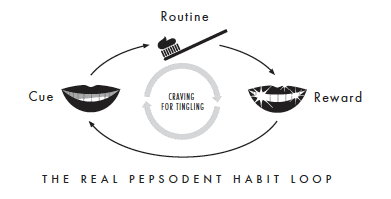
The BIG question is, how can we leverage this in our business? Can we use this to help clients who have been “in the habit” of feeling stressed and worried about their finances? What would it be like if we could train our clients to develop new habits that would alleviate their stress and worry?
First we must identify opportunities for better habits. For instance:
Client Receives Bonus –> Suggest Habit To Save
What if we could help clients alter their habit loop around bonus time? The typical trigger is the bonus hits their account. The routine is that they simply spend down their bonus, and the reward is temporary stress relief. The new routine might be that we help them calculate how much to keep in their account, investing the rest in their brokerage account for a trip they plan to take in 10 years. The reward then becomes excitement for the future and provides the family with something to look forward to down the road.
Client is Financially Disorganized –> Offer Organized Habit
Many clients initially walk in the door financially disorganized. They have accounts in various places, have no idea how their investments are performing and simply don’t have time to track all of this information.
Here is their current habit loop. The trigger (or cue) is stress coming from the fear of not knowing where they stand with their finances. The routine is that they panic, scramble to find their usernames and passwords to log into their various accounts, check their balances and haphazardly calculate their performance information over the prior period. The reward is that the unknown becomes known, creating a sense of relief because they have identified where they stand.
What if we could simplify this habit loop for clients? Might that show them that we actually do add value to the relationship outside of managing investments?
A way I’ve seen advisors tackle this is through automatically aggregating accounts. The trigger remains the onset of stress, yet the routine is streamlined because the client simply locates ONE username and password, logs into their dashboard and views the entire portfolio. You can accomplish this with automated software.
Take it a step further and we can actually groom our clients to adopt this process as a habit by sending a periodic email to remind them of these capabilities, sometimes automatically with no work from us. Over time, they know exactly what to do to ease their financial worry, freeing their mind to focus on the more important things in life, like how to create more time with their family. And that’s just one technique to help clients form productive habits in their financial lives.
Many habit loops exist in our clients’ lives. Our job is to identify them and provide a more effective alternative, allowing clients to focus on the important things. In this way, we help them use money as a tool to live the lives they want to live.
What are some habit loops that you’ve identified, for you or clients? How have you altered them to create more efficiency? I welcome your commentary below.
Photo credits: childhood101, mymoneyblog
The post If You Could Teach A Client To Brush Their Teeth, You Can Keep Them Calm About Finances. Here’s Why. first appeared on Blueleaf.
]]>The post How Speaking To A Group of Pilots Made My Teachers-Only Business Take Off first appeared on Blueleaf.
]]>But is this focus making us close-minded? What about marketing-by-association? Could you market to a different group of people, not directly in your niche, and tap their network to find your ideal clients?
I did just that – but by accident.
My practice, Finance for Teachers, markets exclusively to teachers in Illinois. My website is branded to this demographic and speaks in a language that they understand.
However, some non-teachers reach out for help.
 A couple of months ago, I received an email from a retiring pilot who had an informal investing group with other pilots. They meet every month to discuss investing and how they’re preparing to live off of their portfolios in the near future. He had read a guest blog post that I wrote on a leading financial planning blog, and noticed that we were geographically close. He wondered if I would be interested in presenting to the group on investing.
I made sure to talk at length with the gentleman who had contacted me to understand what the group needed, but I made sure to maintain my brand while I was there. After this conversation, I decided to present and educate and get the word out about my niche focus.
After engaging in a discussion for a couple of hours about investing philosophies, the state of the regulatory bodies in the industry and other topics, one quiet gentleman at the back of the room spoke up. He stated that he wasn’t a pilot, but a retired teacher. Two other gentlemen joined in, and told me that their children were teachers.
In the following weeks through various discussions, I have generated more potential business than any other event in which have presented. It still baffles me to this day.
So, the natural question becomes how can advisors find (and leverage) these kinds of opportunities? I’ve identified a few to get started with.
1. Network with other advisors: Some of my peers told me not to do this presentation as it strayed from my niche. However, the only reason this pilot called me was because of a guest blog post I wrote on a leading financial planning blog. Search out opportunities to get your name, brand and content in the financial planning community (local and online). If you are able to leverage other planner’s viewers and networks, you can also get yourself in front of their audience, who may fall into your niche. Check out ‘Why Referral Marketing Failed You and How To Fix It’.
2. Seek to serve: I went into this presentation with the hope of helping people – I wasn’t going to seek business. Do this in your local community: seek to serve in an area you feel passionate about. It should have nothing to do with your business-growth efforts. Sometimes not looking for the business is a catalyst for it finding you.
3. You don’t know who people know: As a niche-advisor, I only market to a certain demographic. If you target a niche, talk to people who aren’t in that niche and impress them, they may tell your ideal clients about you. The same can be said for your practice: your direct marketing is only reaching a small population. By letting those not in your ideal market know who you are, they can do some of the heavy lifting for you.
4. Maintain your niche focus: When you find these opportunities, you may be tempted to bury your brand and message in order to appeal to most people in the room. Don’t do that. Believe in what you have built, even if you narrow down your chances of generating business at the event. If you come across with a focused business model, you become more easily referable to those people who come into contact with you.
5. Don’t outreach your comfort zone: While speaking with these pilots, we discussed topics I was comfortable with. However, if they had wanted to talk about investing in their pilot plans, I would have had to decline the invitation. As a niche planner, you have expertise in certain areas. This expertise makes you stand out in the crowd as people consider you a specialist in your chosen niche. Don’t try and go back to being a generalist for the sake of an audience. Speak with confidence on subject matters that you know, as that confidence will help strengthen the appearance of your expertise.
Simply by taking off our ‘niche blinders’, we open our eyes to the possibility for these seemingly non-targeted conversations to effectively grow our business.

Photo credit: Telstar, Flickr
The post How Speaking To A Group of Pilots Made My Teachers-Only Business Take Off first appeared on Blueleaf.
]]>